

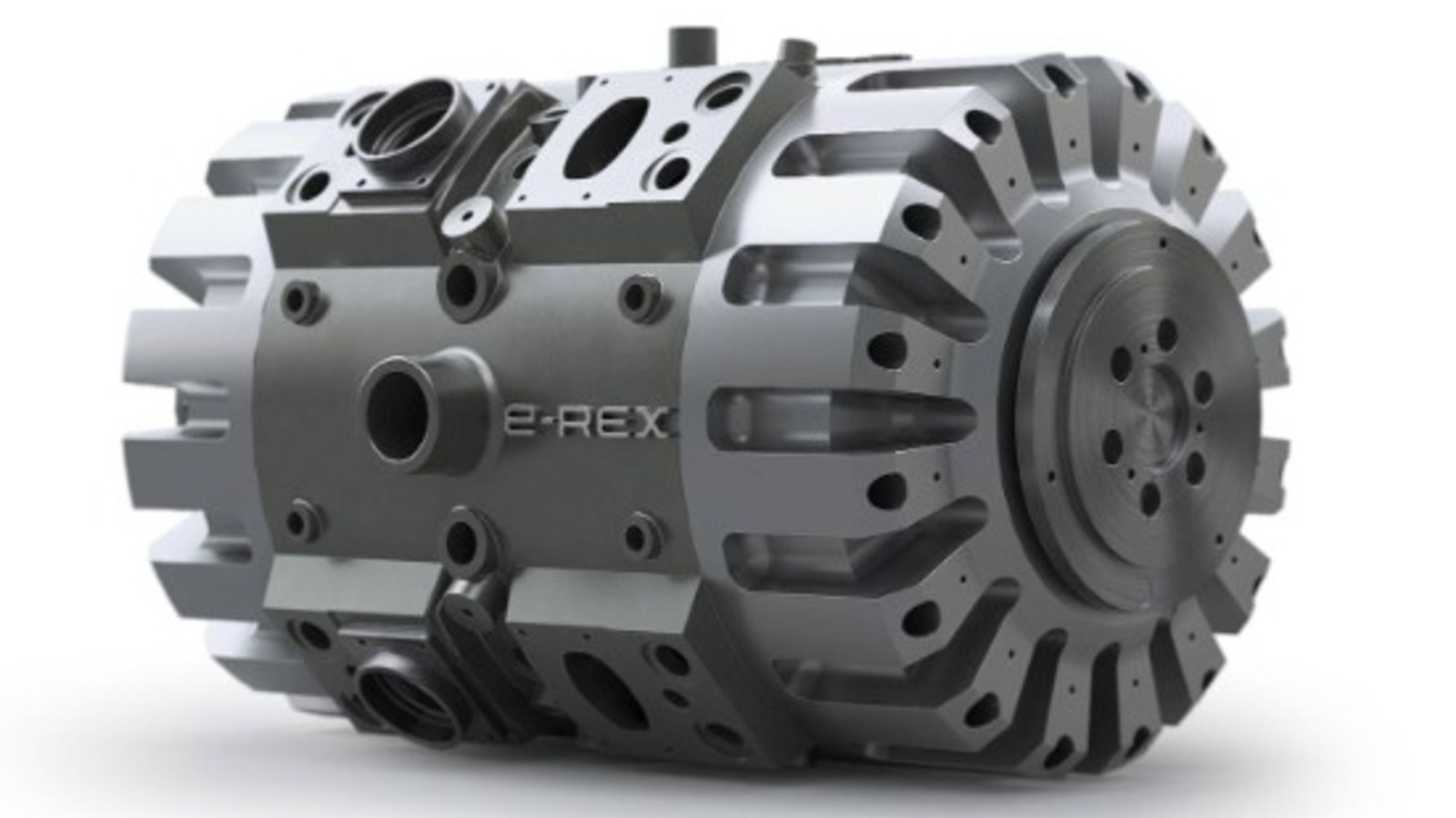
In a world filled with distinctive engine designs, the latest innovation from INNengine has truly sparked curiosity: the e-Rex. This design from Granada, Spain, promises a fresh approach to engine technology.
INNengine has introduced the e-Rex alongside its sibling, the Rex-B. The e-Rex features an innovative configuration with eight pistons driving only four cylinders, facilitating both air intake and exhaust—an idea borrowed from traditional two-stroke mechanics.
The pistons operate on a unique spinning disk mechanism, known as a “thrust plate.” This design uses two plates for the e-Rex’s dual piston sets, while the Rex-B operates with a single plate.
INNengine touts its “1Stroke” system, which combines the combustion and exhaust processes into a single stroke; however, it remains a two-stroke design, aimed at evolving the image of traditional two-stroke engines.
A Vibration-Free Experience
The configuration of opposing pistons in the e-Rex ensures a well-balanced experience, significantly reducing vibrations. A fascinating coin test demonstrated the e-Rex’s stability compared to a typical car engine.
The engine’s thrust plates can adjust synchronously, allowing for changes in compression ratios without complex variable compression designs. Weighing in at just 85 pounds at 500 cubic centimeters, the e-Rex is compact and has been tested in vehicles like the Mazda Miata.
While a supercharger was noted during testing, it’s likely intended to enhance scavenging, vital for efficient air intake without residual exhaust.
Streamlining Design
One notable aspect of the e-Rex is the reduction in moving parts, eliminating complex valve trains and minimizing direct injection issues. The design prevents deposit buildup experienced in conventional systems, as piston movements handle opening and closing ports seamlessly.
The e-Rex is envisioned primarily as a range-extending device for electric vehicles, functioning as a battery charger. The aim is for efficiency and emissions comparable to four-stroke engines, while aspiring for a power density typical of two-stroke designs.
The term “1Stroke” serves as a marketing decision rather than a technical description. A genuine one-stroke classification would require power generation throughout each crankshaft rotation; instead, the design fosters a nuanced approach to combustion mechanics.