

Revamping Chip Technology: Scanning the Horizon
A new chapter in optical technology is unfolding with the development of advanced nanophotonic waveguide chips, promising to enhance beam scanning capabilities worldwide. This innovative technology leverages cutting-edge microfabrication techniques to provide telecommunications and automotive industries with unprecedented accuracy and efficiency.
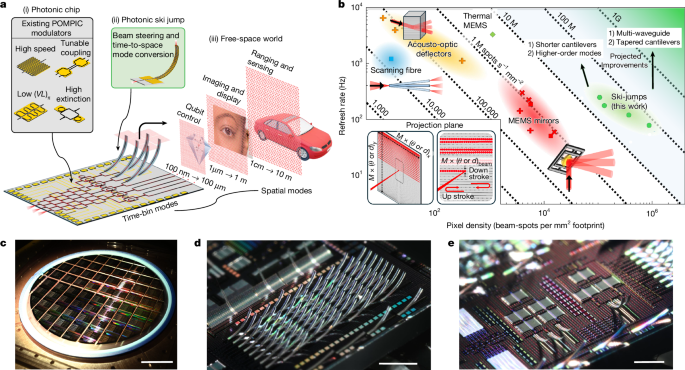
Recent studies have highlighted the significance of these nanophotonic chips in generating precise light patterns. This opens doors for applications such as automotive LiDAR (Light Detection and Ranging), where clear and reliable data is paramount for safety and navigation.
Research indicates that these chips utilize aerial scanning techniques that enhance the flexibility and performance of existing systems, thereby improving their functionality. This has the potential to reshape how industries implement laser scanning technology across various applications.
Furthermore, the integration of micro-sized acousto-optic devices amplifies operational efficiency, making these systems faster and more responsive. The capability to control light at such a fine scale not only minimizes energy consumption but also maximizes performance in object detection and distance measurement applications.
As we look towards the future, the implications of expanding this technology are vast. Enhanced accuracy in beam scanning may significantly impact how we navigate and interact with our environments, paving the way for smarter solutions in fields ranging from autonomous vehicles to advanced imaging systems.
Key Takeaways
- Innovation in Light Technology: Engineers are utilizing nanophotonic chips, creating significant advancements in beam scanning.
- Broad Applications: These chips hold potential across multiple sectors including telecommunication and automotive technologies.
- Microfabrication Techniques: The integration of micro-sized components increasingly enhances performance and reduces energy costs.
- Impact on Daily Life: As this technology evolves, it may transform navigation methods in industries reliant on precise distance measurement.
- Future Prospects: The ongoing development could lead to more efficient systems, pushing forward applications like autonomous driving and improved imaging technologies.
By examining the advancements in nanophotonic technology and considering its broad applications, we may unlock new opportunities while improving existing systems.