



Recent advancements in artificial intelligence are steering researchers toward a groundbreaking approach in automating scientific discovery. By integrating cutting-edge systems designed to generate and evaluate research autonomously, the prospect of rapid and reliable scientific exploration is becoming ever more tangible.
The AI Research Innovator
This initiative features two principal components: the AI Scientist, tasked with producing original research, and an Automated Reviewer, responsible for assessing its validity. Both systems work synergistically to harness the full potential of AI in scientific discovery.
Overview of the AI Scientist
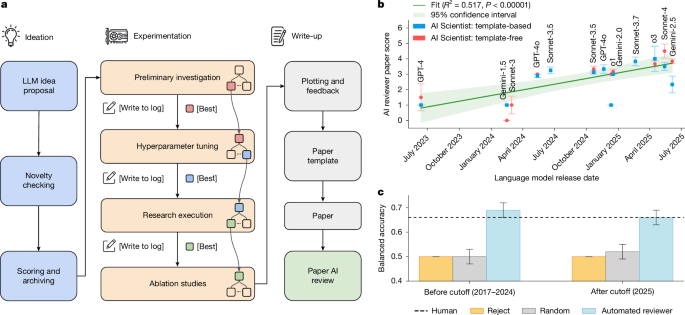
The AI Scientist operates through autonomous mechanisms, adeptly conducting various forms of machine learning research. Two prominent modes are showcased: a template-based system, utilizing a predefined coding framework, and a more flexible, template-free option, which requires minimal initial guidance.
Core Technologies Fueling Innovation
Both models rely on autoregressive language models (LLMs), which are trained to generate text by predicting the next token based on previous ones. These models display capabilities that resemble human reasoning and coding skills through extensive data training. The AI Scientist employs agentic strategies, enhancing performance and dependability while executing coding tasks.
The Structured Workflow
Template-Based System
This version starts with a basic code template, often using a well-known algorithm as a foundation. Its process involves three phases:
-
Idea Generation: Initiated by a human-provided template, the AI enters a loop of proposal and refinement, generating ideas with varied research hypotheses and experimental plans. Thorough checks against existing literature ensure the originality of these ideas.
-
Experiment Execution: After selecting a promising idea, the system outlines a detailed plan for evaluations. It employs robust debugging methods to tackle execution errors, utilizing an automated assistant to generate patches and improve the code continuously.
-
Manuscript Generation: After experiments are run, the findings are synthesized into scientific papers using a LaTeX template. This process includes aggregating experimental results and conducting extensive literature reviews to provide context and support for the findings, followed by thorough editing for clarity.
Template-Free Exploration
To enhance creativity beyond rigid coding templates, the template-free system generates ideas without a fixed initial structure. It articulates research problems and new methods based on a comprehensive literature review. The system coordinates its experimental stages efficiently while managing diverse types of experimental nodes and results.
Continuous Feedback and Improvement
The system employs Visual Language Models (VLMs) to critique generated visual data and ensure clarity, accuracy, and alignment. This feature is crucial for improving the quality of manuscripts, allowing for dynamic interaction between experimental results and their presentations.
Automated Reviewing Process
To evaluate AI-generated research, an automated reviewer function mimics the peer review process of leading machine learning conferences. It produces detailed assessments, providing scores and summarizing strengths and weaknesses of the submitted papers.
Ethical Considerations
The research received ethics approval, ensuring compliance with ethical standards throughout its execution.
Key Takeaways
- Dual Automation Systems: Integration of AI Scientist and Automated Reviewer augments the research process.
- Output Quality: The automated systems are pushing advances in how scientific papers are generated and evaluated.
- Innovation in Methodology: The template-free system embraces creativity while maintaining rigorous scientific standards.
- Real-time Feedback Integration: Using VLMs enhances visualization and ensures clearer presentations of research results.
- Ethical Compliance: Research protocols have been ethically reviewed, promoting transparency in innovative studies.
These insights shape the ongoing dialogue about the balance between human ingenuity and automated advancements in science. As AI continues to evolve, critical considerations arise around quality, originality, and ethical implications.