



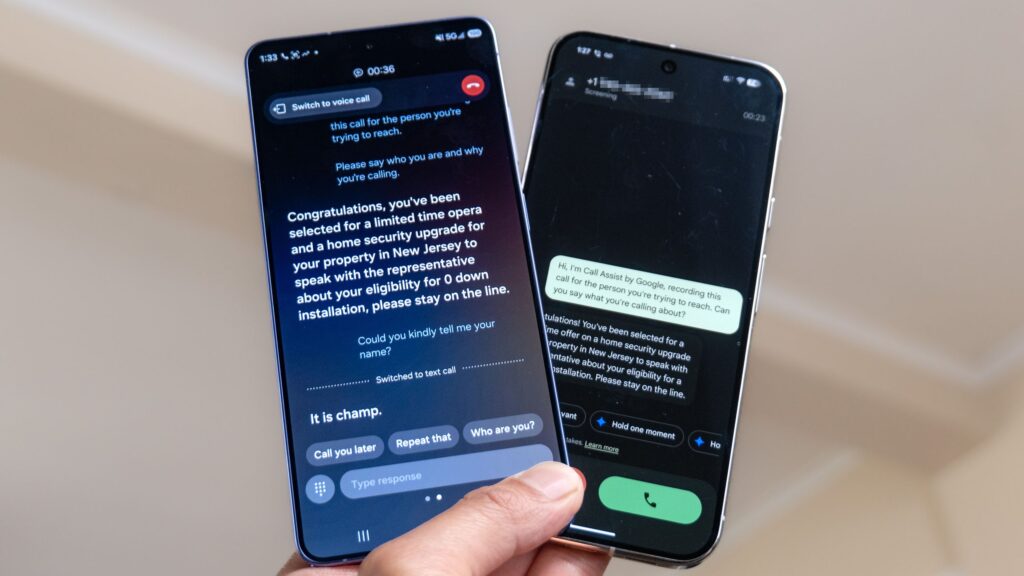
This past week, I compared the Call Screen functionalities of the Galaxy S26 Ultra and the Pixel 10 Pro XL to see which excels in managing incoming phone calls. After previous comparisons favored the Pixel, this test aimed to evaluate if Samsung’s latest flagship can compete.
Google has refined its Call Screen technology, offering practical assistance for handling phone calls. Users with Pixel devices, including the Pixel 10 Pro XL, benefit from advanced capabilities. In contrast, Samsung’s version has recently been introduced with the Galaxy S26, prompting the question: can it compete effectively?
Call Screen Showdown: Galaxy S26 Ultra vs. Pixel 10 Pro XL
I simulated real-life scenarios by calling both devices with a script generated by AI, orchestrating three common types of calls: a package delivery, an appointment confirmation, and a solicitation offer. These scenarios provide insights into each phone’s ability to filter out spam and respond logically.
As someone who avoids unknown callers, I rely on my device to manage these interactions effectively. I focused on the accuracy of transcriptions and how natural each interaction felt within the Call Screen feature.
Test Scenario 1: Package Delivery
In the first test, I initiated a call simulating a delivery. Compared to Google’s service, Samsung’s responses were limited and less helpful. The S26 Ultra offered common phrases like “Repeat that” or “Who are you?” without the necessary context. It was clear that Samsung’s tool lacked the ability to understand conversational cues.
Conversely, the Pixel 10 Pro XL provided a more sophisticated approach, suggesting responses like “leave it by the front door,” which is a practical application for users.
Winner: Pixel 10 Pro XL
Test Scenario 2: Doctor’s Appointment Confirmation
Next, I called to imitate a confirmation for a doctor’s appointment. Again, the Pixel 10 Pro XL excelled, picking up on cues about the appointment time and offering useful options like “confirm” or “cancel appointment.” This contextual understanding is a significant advantage.
In contrast, Samsung’s generic responses failed to effectively address the call’s purpose, leaving me wanting more flexibility in their Call Screen tool.
Winner: Pixel 10 Pro XL
Test Scenario 3: Solicitation Call
Finally, I tested the phones with a solicitation scenario. The Pixel 10 Pro XL recognized the incoming message as spam and provided an option to report the call. This feature is valuable for users aiming to avoid interruptions.
The Galaxy S26 Ultra did not recognize the call as spam and continued to present the same limited responses. Although manual custom responses were possible, the lack of predictive capabilities was a drawback.
Winner: Pixel 10 Pro XL
Final Verdict: Pixel 10 Pro XL vs. Galaxy S26 Ultra Call Screening
The conclusion is clear: Google’s Call Screen functionality on the Pixel 10 Pro XL is significantly more advanced than Samsung’s initial offering with the Galaxy S26 Ultra. The Pixel’s AI-driven interactions provide an invaluable asset for handling calls, allowing users to manage their activities efficiently.
Despite Samsung’s efforts, the gap in technology and understanding between the two brands remains notable. Google’s extensive refinement has made their voice assistant the leading choice for effective call management.
Key Takeaways
- Google’s Call Screen feature demonstrates impressive AI understanding, leading to context-aware responses.
- The Galaxy S26 Ultra’s Call Screen lacks depth and offers generic responses.
- Contextual responses can enhance the phone call experience.
- Both devices support real-time transcription, but the quality of follow-up options varies.
- AI assistance for incoming calls can help users manage time efficiently.