

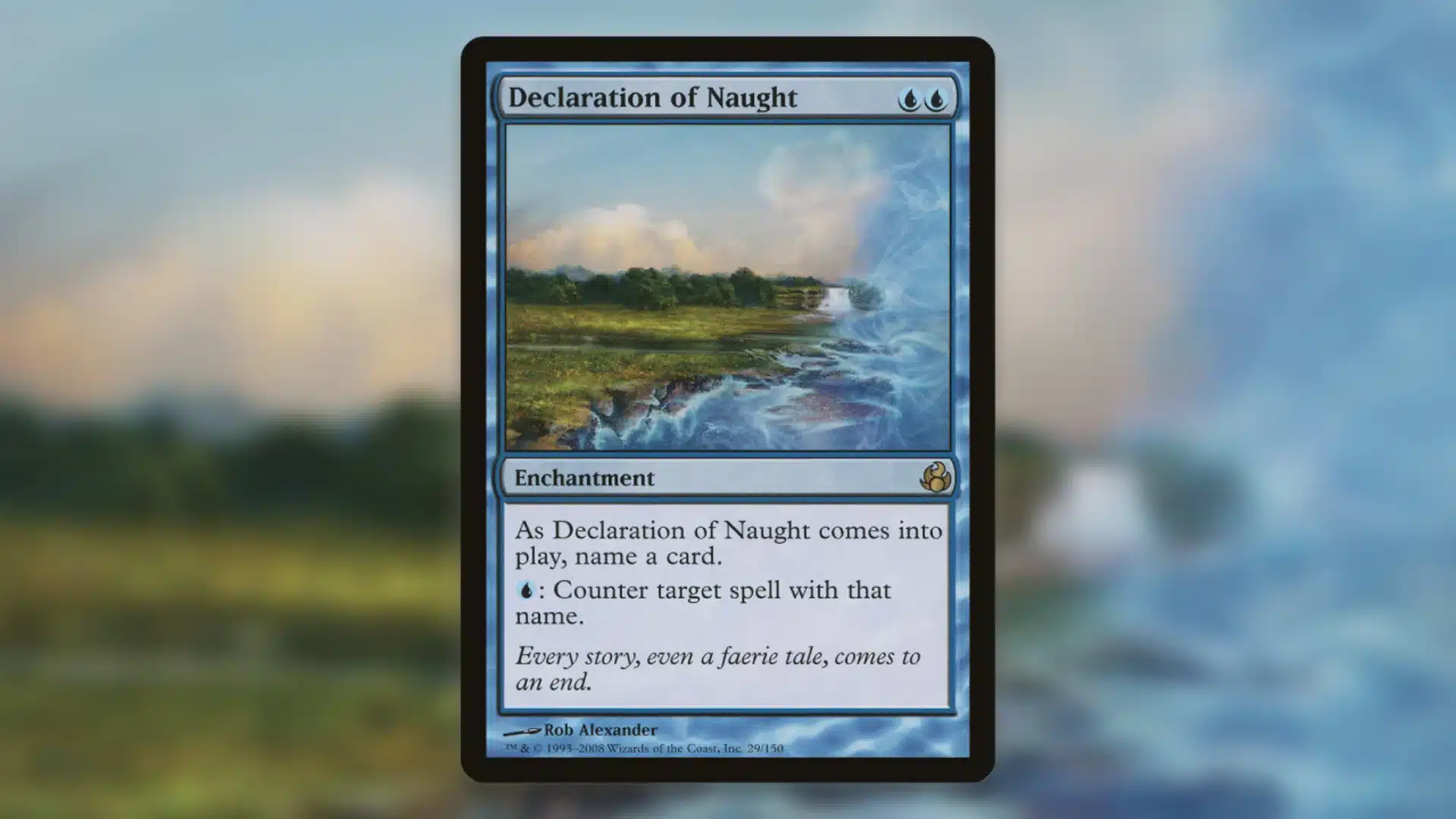
Commander is known for its unique gameplay mechanics, including the singleton rule, varied deck sizes, and a starting life total that sets it apart from other formats. The legendary creatures that serve as commanders are what truly make Commander special, enabling decks to revolve around them. This characteristic makes cards that can neutralize these key figures quite significant.
Recently, the secondary market has illustrated the impact of such cards. “Declaration of Naught,” a lesser-known enchantment from the Morningtide set, has surged in popularity this week, seeing sales and prices soar dramatically. While social media buzz is a contributing factor, the enchantment’s unique ability to completely eliminate opposing commanders is the primary reason behind its renewed interest.
Understanding Declaration Of Naught
Declaration of Naught is an enchantment that hasn’t seen much love since its debut 18 years ago. At first glance, it may appear lackluster: at the cost of three blue mana, players must name a spell they wish to counter, which can be cumbersome and limiting in traditional formats.
However, in Commander, this card takes on a new life. Once played and a commander is named, that commander is effectively out of the game as long as you have blue mana available. Given the importance of commanders in many decks, this can be a lethal blow to an opponent’s strategy. Additionally, with cards like Copy Enchantment, players can enhance this effect by locking out multiple commanders permanently.
But the enchantment’s utility doesn’t stop at commanders. It can also counter powerful win conditions like Thassa’s Oracle and Underworld Breach, both staples in the format. Naming one of these can significantly delay an opponent’s victory. Furthermore, blink effects like Displacer Kitten allow players to reset Declaration of Naught, adapting it as required for different win conditions.
Rising Demand
Following a viral video, sales for Declaration of Naught skyrocketed, with 25 lightly played copies sold in just a few days. Historically, sales for this card hovered around zero to three copies daily, marking a significant change.
The price reflects this new interest—what was once a $3.55 card a month ago has now jumped to around $12.04 on average, marking an astonishing 239% increase for this once-forgotten enchantment. Current values appear to be trending upward, though stability is yet to be established.
For collectors hoping to snag a bargain on this card, the time has passed. It was only printed once, and currently, there are limited copies available, with prices climbing steadily.
Future Prospects
The future of Declaration of Naught remains uncertain in terms of pricing. It is a powerful card that deserves a wider presence in the Commander scene. Data indicates that it features in only 1.98k decks, which seems low given its effectiveness against enemy commanders.
In decks focused on Prison and Stax strategies, Declaration of Naught is a strategic asset. It also fits nicely in Enchantress builds, where it can be easily fetched as needed.
Nonetheless, it carries its share of drawbacks. Despite its potential, it can feel clunky, especially when compared to cheaper counterspells. This limitation might prevent it from becoming a staple card in the format, which could stifle its growth in popularity.
Whether the increased enthusiasm for Declaration of Naught marks a long-term trend or merely a temporary spike is yet to be determined. If its play rate does not maintain momentum, it may return to its previous obscurity. While the card offers certain advantages in Commander, its practicality wanes outside of that environment.
Key Takeaways
- The resurgence of Declaration of Naught highlights its unique position in Commander gameplay.
- The enchantment’s ability to prevent commanders from entering play is pivotal for strategy.
- As demand increases, prices can fluctuate significantly, reflecting changing player interests.
- Players should consider both the advantages and limitations of including specific cards in their decks.
- Continued attention to evolving card dynamics can offer insights into market trends and gameplay strategies.