


Sony’s release of the PS5 Pro features a powerful GPU and advanced capabilities for ray tracing alongside an innovative machine learning upscaler known as PSSR. Early assessments suggested that PSSR struggled at lower resolutions, often underperforming compared to other upscaling technologies like FSR2. This narrative began to shift with the introduction of the revised PSSR, showcased in *Resident Evil Requiem*. How does the upgraded technology fare across a broader range of titles?
Recently, a handful of games were tried out, including *Silent Hill f*, *Final Fantasy 7 Rebirth*, *Monster Hunter Wilds*, and *Dragon Age: The Veilguard*. The revamped PSSR isn’t merely a port of AMD’s FSR4 for PlayStation 5 Pro; it represents a fusion of Sony’s and AMD’s expertise under a collaborative project known as Project Amethyst. Sony’s improvements to the PSSR will likely enhance future iterations of FSR4.
The improved PSSR on the PS5 Pro is a fulfilling advancement. For a clear demonstration of the new upscaler in action, *Silent Hill f* serves as a prime example. The original PSSR had shortcomings—such as shimmering details—especially when faced with Unreal Engine 5 challenges. The new PSSR addresses these concerns effectively, eliminating ray tracing issues and ensuring sharp rendering.
Across all tested games, the native resolutions remained unchanged; however, the final output on a 4K screen now appears cleaner and more visually pleasing. This transformation has turned *Silent Hill f* into a testament of PSSR’s capabilities.
Looking at *Final Fantasy 7 Rebirth*, the enhanced PSSR successfully resolves earlier issues, offering clearer edges and smoother motion with reduced aliasing. Texture quality has improved due to the algorithm’s ability to render higher detail materials stably, making the game not only meet but exceed its frame rate goals.
In *Dragon Age: The Veilguard*, there are modest enhancements, particularly in foliage quality. Meanwhile, *Monster Hunter Wilds* benefits from upgraded anti-aliasing and improved reflection stability, showcasing tangible quality uplift.
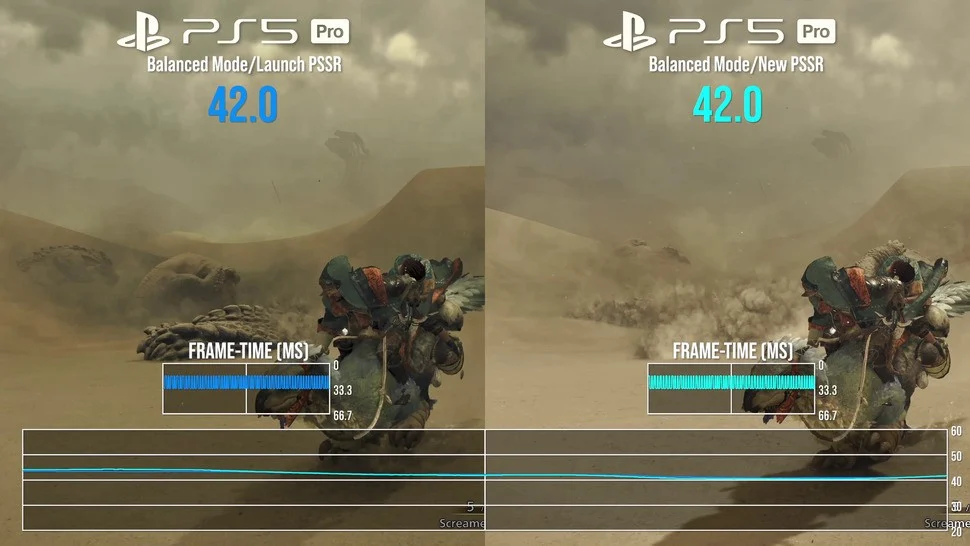
Extended cutscenes in *Monster Hunter Wilds* show that the performance remains nearly identical to the earlier version, suggesting that the cost of “PSSR2” is almost on par with its predecessor. Players can expect improved image quality without reduced frame rates, indicating significant enhancements while maintaining computational efficiency.
All tested titles featured updates made specifically for the new PSSR, not the result of a system-level toggle. The revamped upscaling technology achieves the enhancements anticipated from the PS5 Pro, focusing on bolstering ray tracing and machine learning proficiency. This is encouraging news for gamers.
As we look forward, the evolution of machine learning functionalities of the PS5 Pro remains to be seen. Future updates could introduce features similar to FSR Redstone for frame generation or ray reconstruction. For now, the PS5 Pro is a considerable stride toward realizing its original potential.
Key Takeaways
- The upgraded PSSR offers a significant improvement in visual quality across key titles.
- Technological collaboration between Sony and AMD benefits gamers with better graphics.
- Enhancements include crisper texture details and fewer unwanted artifacts.
- Performance remains stable, maintaining frame rates while improving image fidelity.
- The PS5 Pro’s ambitions for more advanced machine learning features remain to be seen.